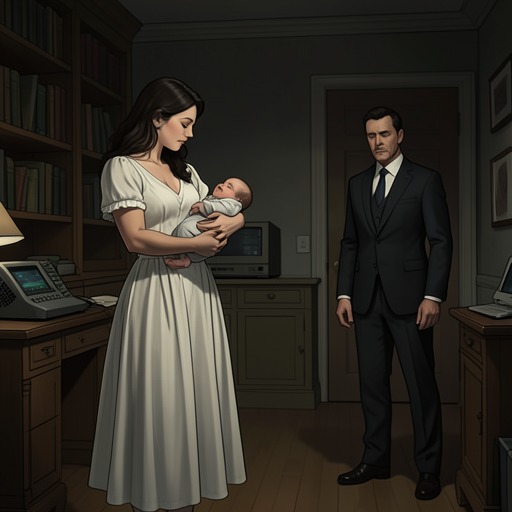
Thea
The Vampire Prince’s BrideThea is a twenty-one-year-old witch and the central protagonist of “The Dragon Shifter’s Love Potion.” Her decisive significance lies in the collision between magical agency and emotional uncertainty: she can prepare a potion intended to make Logan love her, but she cannot guarantee that the spell will create a feeling that was not already present. Her story therefore moves from secret intervention and romantic desperation toward recognition, pregnancy, and a family formed around a relationship that ultimately proves capable of existing beyond the potion.
Identity and Background
Thea is described as big and beautiful, and she has fallen in love with her best friend Elise’s older brother, Logan. Their closeness gives her unusual access to him: she knows his friends and his habits, and Logan later describes her as the only girl besides Elise around whom he has always felt completely comfortable. Yet that familiarity does not initially reassure Thea. She watches Logan begin dating Sophia, who has recently joined their small social group, and interprets his growing attachment to Sophia as a threat that must be stopped.
Thea’s identity as a witch is practical rather than ornamental. She understands potion-making and works from a book of instructions, but a love potion remains unfamiliar territory even to her. The preparation takes place inside the closet of her dorm room, where she gathers crushed herbs and other ingredients, including a dove feather, oyster oil, rose petals, lavender, and her own saliva. She uses test tubes, a flask, a candle, and repeated heating, cooling, and stirring to produce the mixture. She tastes it to check whether it is burnt, rotten, too strong, or likely to be disguised by another flavor. The scene presents magic as a craft requiring technical care, while also exposing the danger of applying that craft to another person’s emotions.
Love Potion and Romantic Conflict
Thea’s potion is governed by a crucial limitation: it works only when the drinker already has some feelings for the maker. That condition makes her plan neither wholly fraudulent nor securely hopeful. The potion cannot manufacture an entirely empty attachment, but it can interfere with uncertain feelings and make Thea mistake magical influence for emotional proof. Her act is driven by fear that Logan is falling for Sophia, not by indifference to Logan’s freedom; nevertheless, she deliberately spikes his drink while arranging a distraction for Elise.
Later, Logan comes to Thea’s dorm room. When he asks her to let him in, she opens the door with excited anticipation. He is sober, which matters to Thea because she does not want their intimacy to be explained only by alcohol. Logan enters, pulls her close, and kisses her, and she kisses him back. The moment seems to confirm the potion’s success, but its apparent certainty is unstable. Logan subsequently acts as though he has changed his mind and tells Thea that he cares about her but does not have feelings as strong as love. The reversal leaves her confronting the possibility that the encounter she treasured was produced by a mixture of desire, alcohol, friendship, and magic rather than by a settled commitment.
Thea eventually admits that she gave Logan the potion. This confession changes the meaning of their earlier encounter. Logan does not simply reject her or treat the disclosure as the end of their relationship. Instead, he recognizes that their long friendship has always made her uniquely important to him. He says that he wanted her even before the potion, recalling that his attraction existed years earlier, when he accidentally saw her naked as a teenager. The revelation does not erase the ethical problem of the potion, but it distinguishes the spell’s influence from Logan’s underlying desire. Thea receives evidence that the relationship was not entirely fabricated by magic, even though her attempt to secure it began with manipulation.
Pregnancy and Family Formation
Thea tells Logan that she became pregnant from that night. At first she phrases the disclosure uncertainly, saying that something “sorta” happened and then clarifying that she is pregnant. The announcement forces the pair to confront consequences that neither romantic uncertainty nor magical ambiguity can postpone. Pregnancy turns the earlier encounter from a private emotional experiment into a continuing material reality, binding Thea and Logan to decisions about the child and the supernatural inheritance the child may carry.
Logan’s response is shaped by the recognition that Thea is not a stranger or a passing attraction. She is the friend who knows him better than almost anyone, and that history becomes the basis for a relationship he can acknowledge without the potion. Thea’s own confession also marks a shift in her position: she stops hiding the mechanism she used to pursue Logan and allows the truth of her conduct, her pregnancy, and her feelings to exist together. The story does not present her as simply innocent or simply villainous. Her love is genuine, but her method is coercive enough to create lasting doubt; her development comes through admitting what she did and facing what followed.
Birth of Alora
Thea gives birth with Logan holding her hand. During labor, the midwife urges her through one final push, after which a daughter is delivered and placed on Thea’s stomach beneath a blanket. The child appears mostly human but has purple scales across her arms, legs, and stomach. Those visible marks confirm that the baby is a shifter and connect Thea’s family directly to Logan’s nonhuman inheritance.
The birth cannot take place in an ordinary hospital because the child’s nature would reveal itself immediately. Logan’s parents have explained that the scales will fade over the following hours and days, allowing the girl to appear human for several years. In toddlerhood, however, she will begin to understand and grow curious about her other nature, and she will eventually start to shift. Thea’s motherhood therefore carries both an immediate joy and a long-term responsibility: she is not merely raising a child whose identity must be concealed, but one whose transformation will make that identity increasingly difficult to hide.
Change and Narrative Significance
Thea begins as someone who tries to control romantic uncertainty through a potion. Her fear of losing Logan to Sophia leads her to substitute magical action for honest vulnerability, and the potion temporarily gives her the result she wants: Logan comes to her room, kisses her, and enters an intimate relationship with her. Yet the next-day reversal prevents the spell from functioning as a simple wish-fulfillment device. It exposes the gap between obtaining a response and being loved freely.
Her later confession and Logan’s admission of pre-existing attraction complicate that gap rather than eliminating it. Thea learns that the potion was not the whole explanation, but she also cannot use Logan’s genuine feelings to make the potion harmless. The relationship becomes possible only after the secret is spoken and the emotional history between them is acknowledged. In that sense, her arc follows a transformation from concealment to disclosure: the witch who first hides a vial in her pocket ultimately has to reveal the spell, the pregnancy, and the vulnerability that motivated both.
Thea’s story also joins romantic convention to supernatural inheritance. The love potion promises immediate certainty, while the pregnancy and the birth of a scaled daughter reveal consequences that extend beyond the couple’s fluctuating feelings. The final image of the newborn’s fading scales offers neither a purely human domestic ending nor an entirely fantastical one. It establishes Thea as a witch, mother, and participant in a family whose future will be shaped by the child’s eventual dragon-shifter identity, while leaving the ethical and emotional cost of the potion visible beneath the romance’s hopeful resolution.